Large round bottom flasks are essential for conducting reactions, reflux setups, and scalable synthesis in research and teaching labs. This guide reviews five top options, highlighting capacity, neck design, and glass quality. Each listing includes a direct link to the product, an image, key features, and practical notes for selecting the right flask for your setup.
Summary Table Of Chosen Products
| Product | Brand | Capacity | Joint/Neck | Material |
|---|---|---|---|---|
| Stonylab 5 L Round Bottom Flask | stonylab | 5000 ml | 45/50 outer joint, single neck | Borosilicate glass |
| QWORK Boiling Flask 1000 ml | QWORK | 1000 ml | 24/40 standard taper outer joint, single neck | Borosilicate glass |
| PATIKIL 5000 ml Boiling Flask | PATIKIL | 5000 ml | 24/40 standard taper outer joint, two necks | 3.3 borosilicate glass |
| PATIKIL 5000 ml Boiling Flask Flat Bottom | PATIKIL | 5000 ml | 24/40 standard taper outer joint, single neck | 3.3 borosilicate glass |
| StonyLab 2 L Dual-Neck RBF | stonylab | 2000 ml | 2 necks, 24/40 center and side joints | Borosilicate glass |
Stonylab 5 L Round Bottom Flask
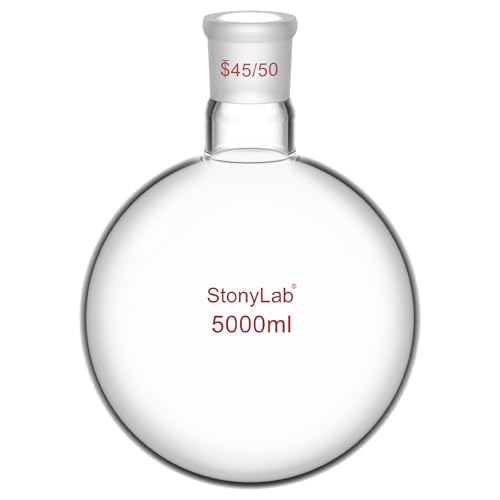
Large-capacity RBFs are designed for high-volume reactions and reflux setups. The Stonylab 5 L flask features a heavy-walled borosilicate body and a single neck with a 45/50 taper outer joint, enabling secure connections to condensers and adapters. Its spherical bottom supports uniform heat distribution, while the thick wall provides robustness against thermal stress during boiling. This model is suitable for scalable lab work and is reusable for multiple experiments.
QWORK 1000 ml Boiling Flask

The QWORK 1000 ml single-neck boiling flask uses high-quality borosilicate glass with a 24/40 standard taper outer joint. It emphasizes a heavy wall for durability and even stress distribution under thermal changes. This model is designed for straightforward heating and reflux activities, and it is hand-blown to ensure consistent wall thickness. It delivers reliable performance in routine chemistry workflows where a compact, robust flask is needed.
PATIKIL 5000 ml Boiling Flask (Two Necks)

The PATIKIL two-neck 5000 ml boiling flask uses 3.3 borosilicate glass rated for high-temperature applications. It features a frosted 24/40 joint for quick and secure setup, along with clear graduations for volume measurement. The heavy-wall design supports pressure and vacuum conditions typical of distillation and reflux processes, making it suitable for larger-scale lab experiments and training environments.
PATIKIL 5000 ml Boiling Flask Flat Bottom

This large flat-bottom variant from PATIKIL provides a stable base for reactions requiring uniform heat distribution at a higher volume. It uses 3.3 borosilicate glass and includes a 24/40 standard taper outer joint. Clear graduations aid in monitoring volumes during setup and reaction progression. The frosted joint interface ensures easier assembly with compatible condensers and adapters, supporting scalable lab workflows.
StonyLab 100 ml Short Neck RBF

The StonyLab small-volume RBF demonstrates the typical features of borosilicate glass with a single short neck and a 24/40 joint. While compact, it highlights the same design principles: a spherical bottom for even heating and a robust neck connection suitable for teaching labs and small-scale synthesis experiments where precision in volume and joint fit matters.
QWORK 1000 ml Dual-Neck Flask

The QWORK dual-neck flask expands setup flexibility with a center and side neck configuration. Built from high-quality borosilicate glass, this heavy-wall design provides durability for multi-branch reactions and complex distillation configurations. The angled necks improve handling and pouring while reducing spill risk, making it a practical choice for versatile lab setups requiring multiple connections.
StonyLab 2 L Dual-Neck RBF
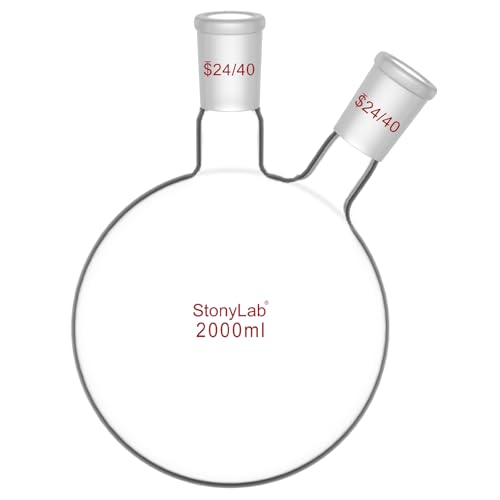
This 2 L StonyLab RBF features two angled necks with 24/40 center and side joints. The dual-neck arrangement supports simultaneous connections to multiple devices, enabling more complex reaction setups, monitoring options, and efficient use of apparatus in larger-scale experiments. The borosilicate glass construction emphasizes durability and thermal stability across varied lab conditions.
Buying Guide: Key Purchase Considerations
When choosing a large round bottom flask, consider capacity versus space in your lab, the type and number of joints, and the glass quality. For high-volume reactions, larger capacities (5 L or more) reduce the need for frequent batch handling but require appropriate storage and safety measures. If you routinely perform reflux or multi-branch setups, flasks with multiple necks (two-neck or dual-neck designs) offer greater flexibility and device integration. Always verify joint standards (usually 24/40 or 45/50) to ensure compatibility with condensers, adapters, and clamps.
Durability and heat resistance are essential. Borosilicate glass provides good thermal stability, while heavy-wall construction reduces the risk of breakage under vacuum or during rapid temperature changes. Consider whether you need flat-bottom stability for certain heating mantles or round-bottom behavior for even heat distribution. For teaching labs or initial setup into a system, single-neck variants with clear graduations simplify operation and measurement.
Maintenance and reusability are practical factors. Glass flasks should be cleaned according to chemical compatibility with residual solvents and reagents. When selecting multi-neck designs, ensure joints are clean and properly lubricated to prevent leaks. If you anticipate frequent disassembly, frosted joints can help with quicker alignment and sealing. Finally, check availability of compatible accessories such as condensers, adapters, and stands to maximize the versatility of your chosen flask.