Finding an affordable laminar flow hood can help labs, mycology setups, and hobbyists maintain sterile workspaces without breaking the bank. Below are five cost-conscious options that balance price with reliable ISO Class 5/100 performance, feature sets, and ease of use. Each product is presented with its key features to assist with comparison and sourcing.
| Product | Filter Type | Working Area | Approx. Airflow | Notes |
|---|---|---|---|---|
| Shroomagic Laminar Flow Hood | H13 HEPA | 20″ × 15″ | 0.35–0.5 m/s | Compact, dual fans, integrated LED |
| Air Science FLOW Series | HEPA | 36″ wide | Not specified (factory installed) | Portable with lights and pass-throughs |
| VEVOR 20″ Wide Hood | HEPA-14 | 26″ x 20″ area | 0.45 m/s | Adjustable airflow, steel frame |
| VEVOR 24″ FFU Hood | HEPA-14 | Large FFU area | 0.51 m/s | Class 100/ISO 5 capable |
| MOFOGDR 17″ Hood | H12 | 17.25″ × 14.82″ | ~1 m/s max (PWM) | Dual fans, compact design |
Laminar Flow Hood with H13 HEPA Filter (20″x15″) — Shroomagic

Overview: This ISO Class 5 laminar flow hood features an H13-grade HEPA filter that removes 99.95% of 0.3µm particles, supporting sterile work in mycology and tissue culture. The unit offers a spacious 20 × 15 inch working area and a top LED light for improved visibility. Dual DC brushless fans help maintain stable laminar flow, with a compact footprint suited to bench-top setups. The included adapter supports 24V DC operation or 100–240V input for flexibility in different labs.
FLOW Series Laminar Flow Hood / Portable Cleanroom — Air Science

Overview: This 36″ wide laminar flow hood provides a larger benchtop surface with factory-installed HEPA filtration and pre-filters. The system emphasizes ease of operation, with standard vapor-proof fluorescent lighting and cable pass-through ports. It includes the electrostatic pre-filter and main HEPA filter pre-installed, offering reliable protection across a range of sterile tasks and demonstrations in cleanroom-like environments.
VEVOR Laminar Flow Hood — 20.08 x 20.47 x 23.62 in

Overview: This portable clean room uses a vertical airflow design with a stepless speed knob and HEPA-14 filtration plus a G1 pre-filter, delivering ISO 5 standards with a 99.997% filtration rate. Its steel frame and stainless base offer durability, while the adjustable airflow helps tailor performance to different experiments. Regular filter replacement every 2–3 months is recommended to maintain efficiency.
VEVOR Laminar Flow Hood — 24.02 x 46.06 x 27.36 in
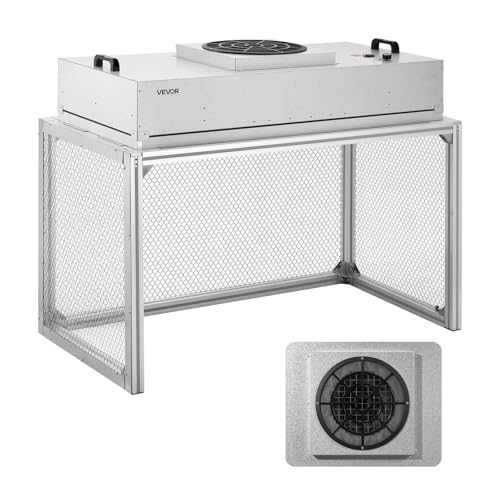
Overview: This larger FFU-style hood is designed to meet Class 100 / ISO 5 standards with HEPA-14 filtration and a G1 pre-filter. It uses a robust metal and aluminum-zinc coated shell for durability in demanding lab environments. The unit features adjustable airflow and is suitable for extended work sessions that require stable, clean air streams.
Laminar Flow Hood with HEPA H12 Filter — YFTOHI

Overview: This compact laminar flow hood uses an H12 HEPA filter with a three-layer filtration setup. It includes dual fans, LED lighting, and a mute design for quieter operation. The unit is designed for mycology, labs, and clean room tasks requiring a stable laminar flow with an approachable price point. It supports 110V operation for easy compatibility with standard outlets.
MOFOGDR Laminar Flow Hood — 17.25″ x 14.82″

Overview: This compact hood uses a dual-fan continuous air supply with a H12 class HEPA filter. It offers a complete operating space around 17.2″ × 7.48″ × 13.07″ with PWM speed control. It is suitable for mushroom rooms, inoculation, and basic lab tasks where a portable, affordable laminar flow solution is desired. The design emphasizes a cost-conscious yet functional approach for hobbyists and small labs alike.
Buying Guide: Key Considerations
- Filtration level and class: For biology and mycology work, HEPA-H13 (ISO 5) or HEPA-14 options provide stronger particulate control compared with H12 models. Consider whether you need certified laminar flow for compliant environments or a high-performance, budget-friendly alternative.
- Airflow and speed control: Look for units with adjustable airflow to match different tasks. PWM-driven fans and stepless controls offer smooth, customizable performance and quieter operation.
- Working area size: Select a size that fits your bench space while providing enough clearance for tools and materials. Larger units improve throughput but require more space and power.
- Build materials: Durable frames (steel or aluminum) and corrosion-resistant basements help extend the unit’s life in labs that handle water, solvents, or chemical residues.
- Maintenance and filters: Check replacement intervals and availability of filters (HEPA and pre-filters). Regular maintenance preserves airflow and cleanliness standards.
- Power and compatibility: Ensure the unit supports your electrical setup, including options for 110V and 220V if needed, and assess whether a DC or AC power supply is preferred for your environment.
- Portability vs. permanence: Portable units are ideal for temporary setups or shared spaces; larger, fixed fixtures suit dedicated cleanrooms or long-term lab stations.
- Noise and comfort: Quieter models reduce disruption during delicate work. Look for ventilation systems with low dB ratings and LED lighting for low heat output and better visibility.
- Warranty and support: A solid warranty and accessible vendor support can mitigate downtime and provide replacement parts when needed.
These options offer a range of sizes, filtration levels, and price points to help budget-conscious buyers achieve clean, controlled workspaces. When selecting, weigh the required ISO class, preferred footprint, and maintenance commitments to find the best balance between cost and performance.