Choosing a reliable double union pressure reducing valve (PRV) helps protect piping, fixtures, and appliances from damaging water pressure fluctuations. This guide highlights five well-regarded options, comparing design, installation, and durability to help American homeowners and pros select a model that fits their system. Each product uses a double union connection for easy maintenance and future serviceability.
Choosing at a glance: The table below summarizes key details for the five featured PRVs, focusing on connection size, typical use, and standout design traits.
| Product | Connection | Typical Use | Notable Feature |
|---|---|---|---|
| Cash Acme EB45 Double Union 2″ | 2 in NPTF | Commercial & Residential | Tamper-resistant design with direct pressure adjustment |
| Zurn Wilkins 34-NR3XLDU 3/4″ | 3/4″ FNPT double union | Compact installations | Short lay length, quick cartridge access |
| Hlieoar 1″ NR3XLDU | 1″ FNPT | Home & light commercial | Bronze body, space-saving dual connection |
| Cash Acme EB45 3/4″ (PVA16P-DUTH-60) | 3/4″ NPTF | Residential, small commercial | Tamper-resistant, NSF/ANSI 372 compliant |
| Snooweerin 3/4″ NR3XLDU | 3/4″ FNPT double union | General plumbing protection | All-bronze construction for durability |
Cash Acme EB45 Double Union 2″ PRV

The Cash Acme EB45 Direct Pressure Regulating Valve (PRV) uses a half cartridge design that combines direct access to the pressure-adjusting screw with a high-quality cartridge valve at regulator price. It regulates downstream pressure in both commercial and residential water systems. The inline 2 in. NPTF double union format provides a tamper-resistant design to lock in the desired system pressure, guarding against accidental adjustments and maintaining safe flow levels. Constructed from brass and stainless steel components, this model withstands corrosion and is NSF/ANSI 372 compliant for potable water use.
Zurn Wilkins 34-NR3XLDU 3/4″ PRV

This model features a short lay length and compact footprint designed for tight spaces. Its cartridge-loaded design simplifies maintenance and repairs, while multiple tailpiece options—threaded, PEX, copper sweat, and CPVC—save time during installation and future service. The double union FNPT connection provides accessible service without extensive disassembly, making it a practical choice for tight plumbing runs in residential and commercial settings.
1″ NR3XLDU Pressure Reducing Valve

This 1-inch valve from Hlieoar regulates high-pressure flow to an optimal level, reducing total usage by a notable margin and potentially lowering monthly utility costs. Its all-bronze body emphasizes durability and corrosion resistance, supporting long-term reliability. The space-saving, dual-connection design allows for quick installation and straightforward maintenance, especially in constrained plumbing spaces common in homes and small commercial setups.
Cash Acme EB45 3/4″ Double Union PRV
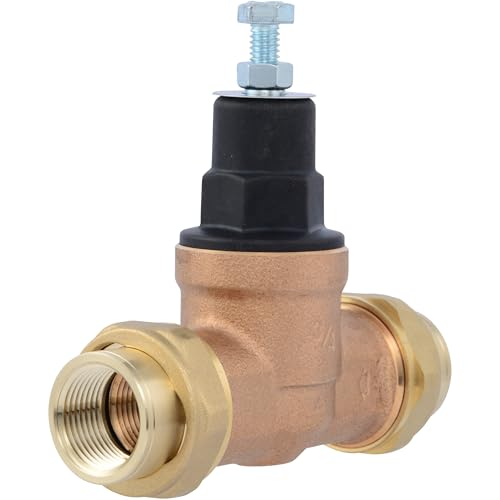
This compact inline regulator uses the EB45 platform with a tamper-resistant design, enabling users to lock in a safe downstream pressure via the adjusting screw. It is built with brass, stainless steel, and durable polymer components to withstand corrosion, and it remains NSF/ANSI 372 compliant for safe potable water use. A 3/4 in. NPTF double union connection supports easier replacement and service without full pipe removal.
Snooweerin 3/4″ NR3XLDU PRV

This 3/4″ NR3XLDU PRV emphasizes versatility and durability, with an all-bronze construction aimed at long-term performance in varied water conditions. It focuses on protecting downstream pipes and appliances by reducing excessive pressure, offering cost-effective protection and compatibility with standard residential and some commercial installations. The double union configuration simplifies future maintenance and component replacement.
Buying Guide: Key Considerations For Double Union PRVs
Selecting the right double union pressure reducing valve involves assessing system pressure needs, pipe sizing, material durability, and ease of maintenance. The following considerations help compare options across brands and models:
- Pressure range and stability: Look for a model with a clearly labeled downstream pressure range and a design that minimizes drift when inlet pressure fluctuates.
- Connection size and layout: Double union configurations differ in size (3/4″, 1″, 2″, etc.). Ensure the valve matches existing piping or offers compatible adapters for a smooth installation.
- Material and corrosion resistance: Bronze and brass bodies with stainless or polymer components withstand potable water environments and reduce corrosion over time.
- Tamper-resistance and safety: Some models include tamper-resistant screws or lock-in features to prevent accidental pressure changes, which is beneficial in shared systems.
- Maintenance and serviceability: Cartridge-loaded designs and short lay lengths ease maintenance. Look for valves with accessible adjustment screws and compatible tailpieces for future repairs.
- Compliance and safety standards: NSF/ANSI 372 compliance and potable water approvals help ensure safe use in home and commercial settings.
- Installation space: In tight spaces, compact or short lay-length models reduce the footprint required for installation and service work.
Consider pairing a double union PRV with routine system checks, especially after changes to incoming supply pressure, after building renovations, or when nearby fixtures show signs of pressure-related issues. A qualified plumber can verify valve calibration and ensure the downstream pressure remains within the recommended range for your home or business.