For students, clinicians, and educators, a 3D heart model that accurately mirrors anatomy is an invaluable teaching tool. This guide highlights top life-size, magnetically assembled heart models with clearly labeled internal structures, designed to support classroom demonstrations, patient education, and professional training. Each option features a detachable wall or modular parts for in-depth study and durable display bases for easy handling.
| Product | Brand | Key Feature |
|---|---|---|
| Axis Scientific Life-Size Heart Model | Axis Scientific | 34 labeled internal structures, magnetic two-part design |
| breesky Life Size Heart Model | breesky | 2-part with detachable front wall, 48 structures |
| TYRRDE Life Size Anatomical Heart Model | TYRRDE | 49 labeled structures, detachable parts, strong magnets |
| breesky Scientific Heart Model | breesky | 2-part, 34 structures, magnet attachment |
| QWORK Life Size Heart Model | QWORK | 2-part with detachable wall, magnetized |
Axis Scientific Life-Size Heart Model

The Axis Scientific life-size heart model presents an authentic representation of cardiac structures with a 2-part design that hides magnets. The front wall detaches for clear, direct viewing of internal features, aiding demonstrations and study. It includes 34 clearly numbered anatomical features, including ventricles, atria, valves, and major vessels, to help learners identify key components quickly. Mounted on a stable base, this model supports repeated use in classrooms or clinical settings.
breesky Life Size Heart Model with 48 Structures

This 2-part life-size heart model from breesky features a detachable front wall and magnets for a secure yet accessible internal view. With 48 labeled anatomical areas, it offers detailed granularity for advanced classroom demonstrations or clinical study. The model measures near the size of a human heart and comes with a base for easy transport and display, making it suitable for classrooms, offices, and lectures.
TYRRDE 2X Life Size Anatomical Heart Model
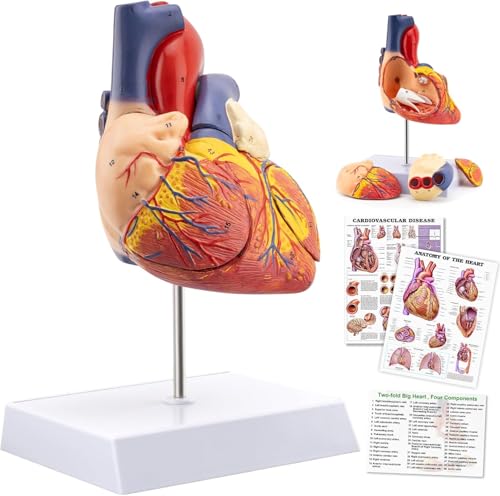
This TYRRDE model enlarges the heart to twice life-size for enhanced visibility of 49 labeled structures. It features four detachable parts and a magnetic assembly for quick disassembly and reassembly. The result is a detailed, hands-on teaching tool ideal for medical teaching, student study, and science demonstrations, especially where close-up inspection is needed.
breesky Scientific 2-Part Heart Model

This 2-part heart model from breesky emphasizes a life-size design with a detachable front wall and 34 numbered internal structures. The model’s base allows for stable display and easy transport to classrooms or offices. The combination of detailed anatomy and a compact footprint makes this a practical choice for demonstrations and patient education alike.
QWORK Life Size Heart Model with Detachable Wall

QWORK’s life-size heart model combines precision and practicality with a detachable front wall held by hidden magnets. This two-part construction supports detailed study and clear demonstration of cardiac anatomy, including the arrangement of chambers and major vessels. It is particularly suited for classrooms and cardiology training sessions where easy access to interior structures is beneficial.
Buying Guide
- Size and realism: Look for life-size models that closely mirror the dimensions of a human heart for accurate spatial understanding. Some models are 1:1 with detailed coloring and textures to resemble real tissue.
- Construction and accessibility: Magnetic detachment or a detachable wall allows students to view internal structures without permanent disassembly. Consider two-part designs for durability and repeated use.
- Labeling and anatomy coverage: Ensure the model includes a comprehensive set of labeled structures (e.g., ventricles, atria, valves, major vessels) to support varied teaching objectives.
- Base stability and portability: A sturdy base facilitates classroom demonstrations and travel between classrooms or offices. Portable, lightweight options are useful for outreach.
- Purity and materials: Non-toxic materials and hand-painted details enhance safety and realism, especially for patient education and hands-on sessions.
- Maintenance: Look for models with easy cleaning and resistant finishes to withstand frequent handling and demonstrations.
- Educational value: Some packages include manuals, reference cards, or color-coding to support instructors and learners in identifying anatomical features quickly.
- Longevity vs. budget: Higher-detail, magnet-based models often cost more but can translate into longer-term value through repeated classroom use and professional demonstrations.
- Use case compatibility: Choose models tailored to your setting—classrooms, clinical training, patient education, or research demonstrations—to maximize learning outcomes.
In sum, the listed models offer varying levels of detail, detachable features, and labeling to accommodate different educational needs. Selecting the right option depends on desired anatomy coverage, ease of access to internal structures, and how the model will be used in teaching or patient education contexts.