Choosing the right 96-well Elisa plate is essential for consistent binding, clear optical readings, and reproducible results. This guide highlights five highly compatible 96-well plates, focusing on surface quality, binding capacity, and compatibility with ELISA workflows. Each product is selected for American labs seeking dependable performance in routine assays, training environments, and research settings.
| Product | Brand | Key Benefit |
|---|---|---|
| ADVANGENE Elisa Polystyrene 96 Well Plate Medium-Binding | Advangene | Optically clear surface, strong binding capacity |
| Globe Scientific 120338 96-Well Plate | Globe Scientific | Sterile, individually wrapped |
| Nest 515201 96 Well Plate, Undetachable | Nest | High binding, medical grade material |
| 96 Well Plate – PCR 96 Well Plate, 0.2 ml | Scienfocus Lab | Uniform wall thickness, good heat transfer |
| Weysat 20 Pcs 96 Well Tissue Culture Plates | Weysat | Clear polystyrene, suitable for teaching and lab work |
Below you’ll find concise product sections with direct links to Amazon, followed by a practical buying guide to help you compare options based on binding capacity, material quality, and intended use. All sections maintain a neutral, objective tone to support informed decisions without external influence.
Advangene Elisa Polystyrene Plate: Medium-Binding

Advangene’s medium-binding polystyrene plate is designed for ELISA-style assays where consistent protein adsorption is essential. The surface is optically clear, helping to produce uniform optical readings across wells. Its surface supports binding of proteins with molecular weights greater than 20 kDa and provides a binding capacity exceeding 200 ng per square centimeter. The plate is manufactured from crystal-grade virgin polystyrene, emphasizing integrity and batch consistency for reliable assay outcomes.
Globe Scientific 96-Well Plate, Sterile

Globe Scientific offers a sterile, 96-well polystyrene plate, flat-bottomed and individually wrapped. The package is suitable for laboratories requiring single-use plates to minimize cross-contamination. The product dimensions and packaging emphasize standardization for high-throughput workflows, with emphasis on ease of handling and consistent well geometry to support uniform assay performance.
Nest 515201 96 Well Elisa Plate

The Nest plate is designed for ELISA methods with a focus on high binding performance. Constructed from medical-grade polystyrene, these plates conform to SBS/ANSI standards to ensure compatibility with automated readers and plate handlers. The undetachable, clear wells support consistent optical measurements while providing reliable adsorption characteristics for typical ELISA protocols.
Scienfocus Lab 96-Well Plate

This 96-well plate is optimized for PCR and ELISA-related applications, featuring a thin-walled polypropylene design that supports rapid heat transfer for even sample heating. The wells are laser-engraved with identification marks for quick sample differentiation. The material choice aims for resistance to high temperatures and repeated use in PCR-related workflows, making it a versatile option for multiple assay types.
Weysat 96-Well Tissue Culture Plates
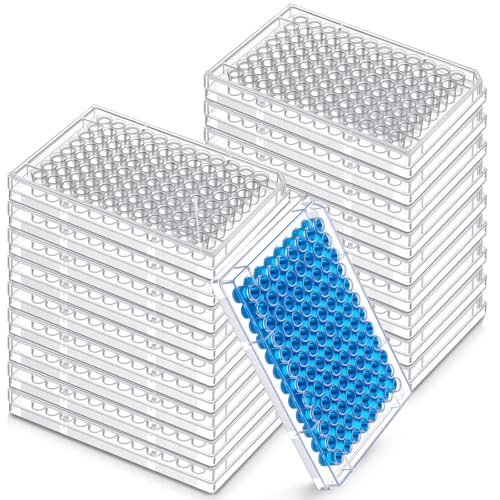
The Weysat set includes 20 tissue culture plates with clear, optically transparent polystyrene. The flat-bottom wells promote uniform sample distribution and are designed for teaching and standard laboratory work. The plates’ optical clarity supports accurate observation and imaging during routine assays and educational demonstrations, with a focus on durability and consistent performance across multiple plates.
PCR Plate Sealing Film (Albert Bio)

The sealing film provides a tight seal to minimize evaporation and condensation during PCR, qPCR, and ELISA workflows. It is free of DNase, RNase, and PCR inhibitors and is designed to minimize skin and glove adherence, reducing the risk of contamination and workflow interruptions. This film is compatible with standard 96-well plates and develops reliable barrier properties during thermal cycling and incubation steps.
Buying Guide
- Plate material: Polystyrene plates offer strong protein adsorption for ELISA assays, while polypropylene variants can handle higher temperatures and repeated cycling. Consider your assay chemistry and incubation temperatures when choosing plate type.
- Binding characteristics: Look for plates advertised as high-binding or medium-binding, depending on your target proteins. Binding capacity, especially for larger proteins, can influence sensitivity and signal strength.
- Well geometry and readability: Flat-bottom wells improve uniformity and reading accuracy in spectrophotometric readers. Clear wells support optical measurements, while opaque variants are preferred for fluorescence-based assays.
- Sterility and packaging: For high-throughput screens or experiments requiring contamination control, sterile, individually wrapped plates reduce handling risks. Detachable vs. undetachable formats affect automation compatibility.
- Compatibility: Confirm SBS/ANSI conformance for automation compatibility, plate readers, and robotic systems. Ensure seal compatibility with sealing films for evaporation control during thermal steps.
- Cost vs. value: Evaluate the total cost per plate, taking into account binding performance, lot consistency, and the expected number of assays. Sometimes a slightly higher upfront cost yields more consistent long-term results.
- Education vs. research use: For teaching or demonstrations, plates that emphasize clarity, uniform walls, and ease of handling may be preferable, while research-focused plates may prioritize binding strength and compatibility with advanced readouts.